
Explore our Quartz Vs Granite Guide.
Not sure whether quartz or granite is right for your home? Both are popular countertop choices, but each has its own advantages. This guide compares durability, maintenance, appearance, and cost to help you make the right decision.
Table of Contents
What Makes Quartz and Granite Fundamentally Different
Durability and Performance in NC Kitchens
Maintenance, Sealing, and Daily Care
Cost Comparison for North Carolina Projects
Aesthetics and Design Flexibility
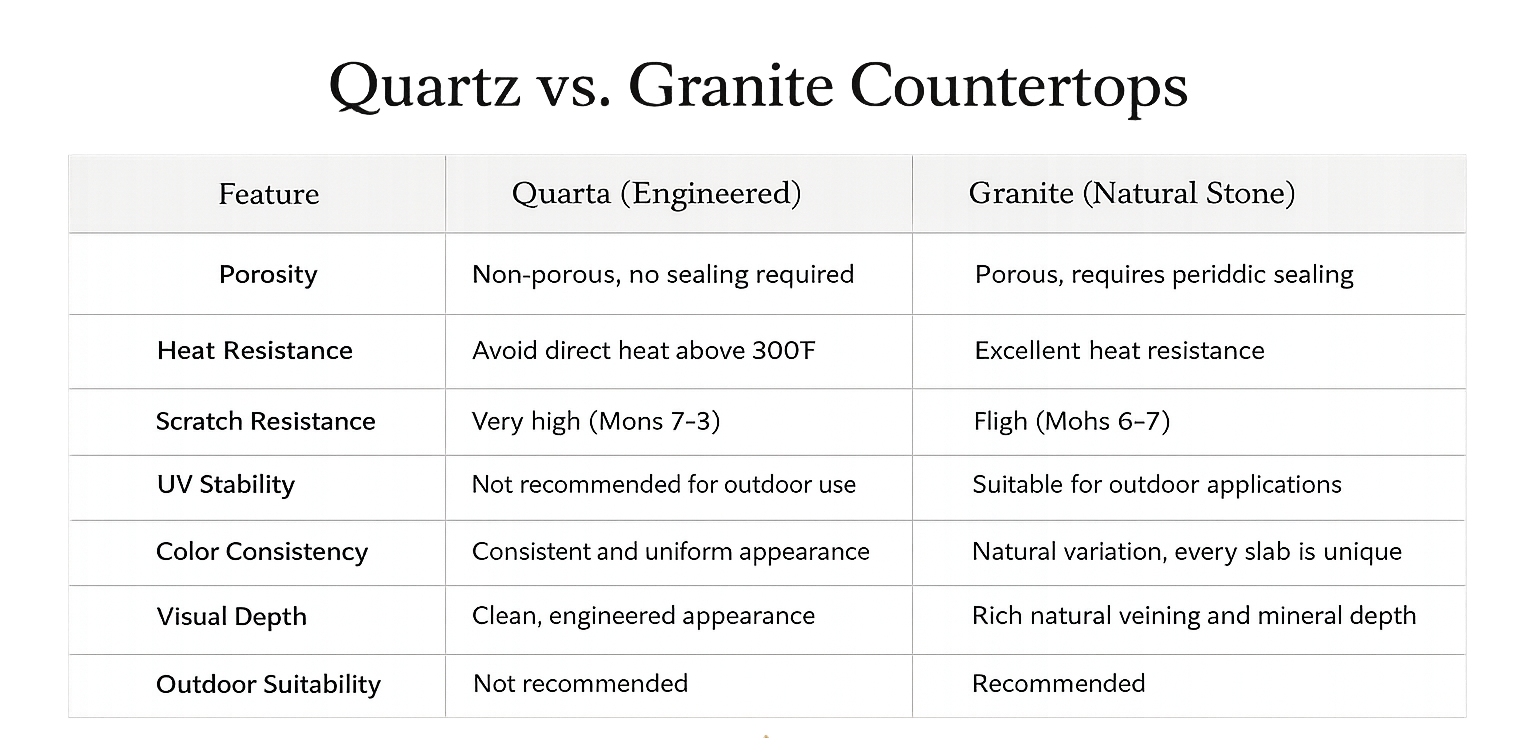
Side-by-Side Material Comparison
Which Material Wins for Specific Use Cases
Working with a Local NC Fabricator
Frequently Asked Questions
Quick Takeaways
Quartz requires zero sealing - Unlike granite, engineered quartz is non-porous by nature, meaning bacteria and liquids cannot penetrate the surface without annual sealing treatments.
Granite offers true uniqueness - Every granite slab is one-of-a-kind. No two kitchens with the same granite variety will look identical, which matters for resale appeal in custom NC homes.
Quartz can warp under direct heat - The resin binders in engineered quartz can discolor or crack under sustained heat above 300 degrees Fahrenheit. Always use trivets near stovetops.
Granite pricing varies by slab origin - Domestic granite slabs tend to cost less than Brazilian or Indian imports. Local NC fabricators like Sondos Stone can show you both options in person.
Fabrication quality matters more than material brand - A poorly fabricated quartz top will fail faster than a well-fabricated granite top. In-house fabrication with experienced craftspeople reduces this risk significantly.
North Carolina humidity affects unsealed granite - High humidity in NC summers can accelerate staining in unsealed or poorly sealed granite. Proper sealing at installation is non-negotiable in this climate.
Quartz dominates new construction right now - Builders across NC increasingly specify quartz for consistency across multiple units. Granite remains the top choice for custom, one-of-a-kind residential kitchens.
What Makes Quartz and Granite Fundamentally Different
Granite is a natural igneous rock quarried directly from the earth. It forms over millions of years under intense heat and pressure, which is why no two slabs are ever identical. The variation in color, veining, and mineral deposits is entirely natural, not manufactured.
Quartz countertops, on the other hand, are engineered products. Brands like Cambria, Silestone, and Caesarstone combine roughly 90 to 95 percent ground quartz with polymer resins and pigments. The result is a highly uniform surface that manufacturers can control for color consistency and density.
This origin difference drives almost every practical difference between the two materials. Natural formation gives granite its beauty and its quirks. Engineered construction gives quartz its predictability and its limitations.
Porosity: The Single Most Important Structural Difference
Granite is a porous material. Its microscopic pores can absorb liquids, oils, and bacteria over time without proper sealing. The porosity level varies by granite type. Lighter granites like White Ice tend to be more porous than darker varieties like Absolute Black.
Quartz is non-porous by design. The resin binders fill the gaps between quartz particles completely, creating a surface that resists liquid absorption without any sealing. For households with young children, heavy cooking habits, or simply low tolerance for maintenance, this difference alone often makes the decision.
Durability and Performance in NC Kitchens
Both materials are genuinely hard surfaces. Granite typically scores between 6 and 7 on the Mohs hardness scale. Engineered quartz scores between 7 and 8. In practice, both will resist scratching from knives and typical kitchen tools without visible damage under normal use.
Where they diverge is thermal performance. Granite handles heat well. Hot pots placed directly on granite rarely cause damage because the natural stone has withstood geological heat for millennia. Quartz does not share this advantage. The polymer resins can discolor, crack, or warp under sustained direct heat, which is a real-world concern for active cooks in NC homes.
Impact Resistance Near Edges and Corners
A common mistake homeowners make is assuming all stone countertops perform equally under impact. They do not. Granite's crystalline structure can chip at thin edges, particularly with ogee or eased profiles, if struck with a heavy cast iron pan or dropped object. Quartz handles impact somewhat better along edges because of its resin composition, but it is not impact-proof.
In practice, Sondos Stone's fabrication team often recommends slightly thicker edge profiles for homes with children or high-traffic kitchen layouts. The edge profile choice affects both durability and appearance, and it is a conversation worth having with your fabricator before the slab is cut.
"The durability of any countertop is only as good as the quality of its fabrication. Precise cuts, proper support, and correct seam placement determine how a slab performs over decades, not just the material itself." - Sondos Stone Fabrication Team, with over 40 years of hands-on experience in NC countertop installation
UV Exposure and Outdoor Applications
North Carolina homeowners increasingly install countertops in outdoor kitchens and covered patios. Granite performs well in outdoor settings. Quartz does not. UV exposure causes quartz surfaces to fade and discolor over time because the resins are not UV-stable. For any outdoor countertop project in NC, granite, quartzite, or Dekton are the correct choices.
Maintenance, Sealing, and Daily Care
This is where the decision often becomes clear for most homeowners. Quartz is the lower-maintenance option, and that statement is not nuanced. Engineered quartz requires no sealing, resists most household stains without special cleaners, and cleans up with soap and water.
Granite requires sealing at installation and resealing every one to three years depending on usage and the specific stone. Skipping this step in North Carolina is a genuine problem. The combination of high summer humidity and kitchen moisture creates conditions where an unsealed granite surface will absorb cooking oils, wine, and acidic liquids more readily than in drier climates.
What Voids Your Countertop Investment
For quartz, the main threats are prolonged UV exposure outdoors, direct heat contact, and harsh chemical cleaners like bleach or high-pH degreasers. These degrade the resin binders and cause discoloration that cannot be repaired without replacement.
For granite, the main threats are acidic liquids like lemon juice, vinegar, and wine sitting on an unsealed or inadequately sealed surface. These etch the stone over time, dulling the finish. Coffee and cooking oils can also leave permanent stains if the surface is not sealed properly.
Cost Comparison for North Carolina Projects
The honest answer on cost is that both materials overlap significantly in mid-range pricing, and the final number depends heavily on slab origin, edge profile complexity, cutouts for sinks and cooktops, and the fabricator's labor rate.
Entry-level granite in North Carolina typically starts around 50 to 55 dollars per square foot installed, including fabrication and installation. Mid-range and exotic granite slabs can run 80 to 200 dollars per square foot installed. Quartz follows a similar curve, with builder-grade options starting around 50 to 70 dollars per square foot installed and premium brands like Cambria reaching 100 to 250 dollars per square foot installed.
Where Homeowners Overpay Without Realizing It
The biggest cost variable most homeowners overlook is slab yield. A poorly planned layout wastes expensive stone. In-house fabrication, like what Sondos Stone offers, means your fabricator controls the templating, cutting, and installation as a single operation. This reduces waste, speeds up turnaround, and eliminates the markups that come from outsourcing fabrication to a third party.
Contractors and builders managing multiple NC residential projects should pay particular attention here. Consistent in-house fabrication across multiple countertop installations means predictable pricing and quality, which matters when managing project timelines and budgets.
Aesthetics and Design Flexibility
Design preferences are personal, but there are objective differences in what each material can deliver. Quartz gives you consistency. If you select a specific color for an open-plan kitchen with an island, the island top and the perimeter countertop will match precisely because they come from the same engineered batch.
Granite gives you movement, depth, and character that engineered surfaces cannot replicate. The natural variation in veining and mineral deposits creates surfaces that look genuinely alive under changing light conditions. Many NC homeowners who invest in custom kitchens specifically choose granite to avoid the look of a manufactured product.
Matching Countertops to NC Interior Design Trends
White and light gray kitchens with waterfall islands have dominated NC residential construction for several years. Both quartz and granite serve this trend well, but they serve it differently. White quartz options like Calacatta Gold from Caesarstone or Brittanicca from MSI offer a clean, repeatable white-and-gray vein pattern. White granite options like White Macaubas or Alaska White offer a softer, more organic look that pairs well with painted cabinetry and hardwood floors common in traditional NC home designs.
For homeowners pursuing a more dramatic look, granite slabs with strong blue, green, or gold mineral deposits are impossible to replicate in quartz. No engineered product matches the visual depth of a raw slab of Titanium Granite or Kinawa Green.
Which Material Wins for Specific Use Cases
Vague comparisons frustrate homeowners who need to make a real decision. Here is a direct call for the most common North Carolina countertop scenarios, based on what Sondos Stone has seen work and fail across decades of residential and commercial projects in NC.
High-Traffic Family Kitchens
Quartz wins. The combination of non-porous surface, stain resistance, and zero sealing requirements makes quartz the better choice for households where cooking is frequent, kids are present, and cleanup needs to be fast and simple.
Custom Luxury Kitchens and Showpiece Installations
Granite wins. Homeowners investing in a custom kitchen that needs to be visually distinct and reflect natural beauty should choose granite. The depth and uniqueness of a high-quality granite slab cannot be matched by any engineered product at any price point.
Outdoor Kitchens and Covered Patios in NC
Granite wins without question. North Carolina summers expose outdoor surfaces to intense UV, heat, and humidity. Quartz will fade and degrade in this environment. Granite, quartzite, or Dekton are the only sensible choices for exterior countertop applications in this region.
Commercial and Multi-Unit Builder Projects
Quartz wins for builders and commercial operators who need consistent color, low maintenance, and fast turnaround across multiple installations. The engineered uniformity of quartz simplifies procurement and reduces the slab-selection time that natural stone requires for each individual unit.
Working with a Local NC Fabricator
The material choice matters. The fabricator choice matters just as much. A poorly fabricated quartz or granite countertop will underperform regardless of material quality, and it will cost you more in the long run than making the right fabrication investment upfront.
Sondos Stone has operated in North Carolina since 1982, offering in-house templating, fabrication, and installation as a single seamless service. That means the same team that measures your kitchen cuts your slab and installs your countertop. There is no handoff to a third-party fabricator, no communication gap, and no accountability gap when something needs to be corrected.
What to Ask Any NC Fabricator Before You Commit
First, ask whether fabrication is done in-house or outsourced. Outsourced fabrication increases turnaround time and reduces quality control. Second, ask to see their templating process. Digital templating reduces measurement errors that lead to poor seam placement and ill-fitting countertops. Third, ask specifically about sealing: what product they use, whether it is included in the installation price, and what their warranty covers.
The fabricators who hesitate on these questions or give vague answers are telling you something important. The fabricators who answer with specifics and invite you to see their facility are the ones who have nothing to hide.
Frequently Asked Questions
Is quartz or granite better for North Carolina's humid climate?
Quartz handles humidity better in interior applications because its non-porous surface does not absorb moisture. Granite performs well in NC humidity only when properly sealed. For outdoor applications in NC's hot and humid summers, granite is the superior choice because quartz degrades under UV exposure.
How often does granite need to be sealed in NC homes?
In North Carolina, most granite countertops should be resealed every one to two years for kitchen applications, and every two to three years for bathroom vanities with lighter use. Higher porosity granites and lighter-colored stones need more frequent sealing. A quality impregnating sealer applied at installation extends this interval.
Can I put hot pans directly on quartz countertops?
No. The polymer resins in engineered quartz can discolor, crack, or warp under sustained heat above approximately 300 degrees Fahrenheit. Always use trivets or heat-resistant pads near stovetops and ovens. Granite handles direct heat significantly better, though using trivets on any stone surface is still a good practice.
What is the typical turnaround time for custom countertop fabrication at Sondos Stone?
Sondos Stone offers fast turnaround times as part of its in-house fabrication model. Because templating, cutting, and installation are handled by the same team without outsourcing, most residential projects can be completed faster than fabricators who use third-party cutting facilities. Contact Sondos Stone directly for a current timeline estimate specific to your project scope.
Does quartz or granite add more resale value to a North Carolina home?
Both materials add meaningful resale value over laminate or tile countertops, and neither consistently outperforms the other in NC real estate markets. What matters more to buyers is quality of fabrication, condition of the surface, and whether the countertop visually fits the overall kitchen design. A well-maintained granite countertop in a custom kitchen often appeals more to luxury buyers, while quartz appeals to buyers prioritizing low-maintenance living.
Can quartz be used for outdoor kitchens in North Carolina?
No. Quartz should not be used outdoors in North Carolina. UV exposure causes the resin binders in engineered quartz to fade and discolor, typically within one to two years of outdoor installation. Granite, quartzite, and Dekton are the appropriate materials for NC outdoor kitchen countertops.
What is the difference between quartz and quartzite countertops?
Quartz is an engineered product made from ground quartz crystals and resin binders. Quartzite is a natural metamorphic stone, harder than granite, that forms when sandstone is subjected to intense heat and pressure. Quartzite is UV-stable and suitable for outdoor use, unlike engineered quartz. The two names are frequently confused, so always confirm which material a fabricator is quoting before proceeding.
If you have recently installed quartz or granite countertops in your North Carolina home, share what influenced your final decision in the comments, because your real-world experience helps other homeowners make smarter choices.